


Page 128 - Math Course 2 (Book 1)
P. 128
Perfect Square Trinomials


                                                           Factor Completely
                      Let’s Begin
                                                            Examples


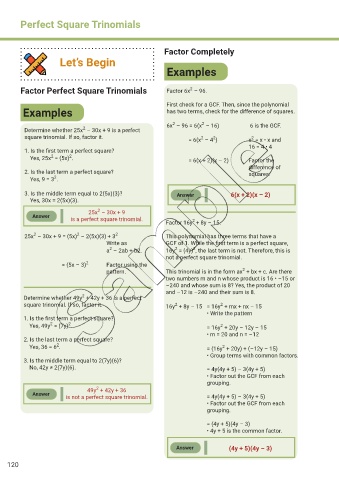
        Factor Perfect Square Trinomials                    Factor 6x  – 96.
                                                                    2
                                                            First check for a GCF. Then, since the polynomial
         Examples                                           has two terms, check for the difference of squares.

                                                              2
                                                                        2
                                                            6x  – 96 = 6(x  – 16)        6 is the GCF.
                              2
          Determine whether 25x  – 30x + 9 is a perfect
          square trinomial. If so, factor it.                       = 6(x  – 4 )        x  = x • x and
                                                                        2
                                                                            2
                                                                                         2
                                                                                        16 = 4 • 4
          1. Is the f rst term a perfect square?
                   2
                         2
              Yes, 25x  = (5x) .                                    = 6(x + 2)(x – 2)   Factor the
                                                                                        difference of
          2. Is the last term a perfect square?                                         squares.
                    2
              Yes, 9 = 3 .
          3. Is the middle term equal to 2(5x)(3)?             Answer             6(x + 2)(x – 2)
              Yes, 30x = 2(5x)(3).
                                   2
                                25x  – 30x + 9
            Answer
                          is a perfect square trinomial.             2
                                                           Factor 16y + 8y – 15.
                                          2
                            2
             2
          25x  – 30x + 9 = (5x)  – 2(5x)(3) + 3            This polynomial has three terms that have a
                                      Write as             GCF of 1. While the f rst term is a perfect square,
                                                              2
                                       2
                                                                     2
                                      a  – 2ab + b2.       16y  = (4y) , the last term is not. Therefore, this is
                                                           not a perfect square trinomial.
                             = (5x – 3) 2   Factor using the
                                                                                      2
                                      pattern.             This trinomial is in the form ax  + bx + c. Are there
                                                           two numbers m and n whose product is 16 • –15 or
                                                           –240 and whose sum is 8? Yes, the product of 20
                                                           and –12 is –240 and their sum is 8.
                              2
         Determine whether 49y  + 42y + 36 is a perfect
         square trinomial. If so, factor it.               16y  + 8y – 15   = 16y  + mx + nx – 15
                                                              2
                                                                              2
                                                                          • Write the pattern
         1. Is the f rst term a perfect square?
                         2
                   2
             Yes, 49y  = (7y) .                                                         = 16y  + 20y – 12y – 15
                                                                              2
                                                                          • m = 20 and n = –12
         2. Is the last term a perfect square?
                     2
             Yes, 36 = 6 .                                                = (16y  + 20y) + (–12y – 15)
                                                                               2
                                                                          • Group terms with common factors.
         3. Is the middle term equal to 2(7y)(6)?
             No, 42y ≠ 2(7y)(6).                                          = 4y(4y + 5) – 3(4y + 5)
                                                                          • Factor out the GCF from each
                                                                          grouping.
                                   2
                                49y  + 42y + 36
            Answer
                        is not a perfect square trinomial.                = 4y(4y + 5) – 3(4y + 5)
                                                                          • Factor out the GCF from each
                                                                          grouping.
                                                                          = (4y + 5)(4y – 3)
                                                                          • 4y + 5 is the common factor.

                                                               Answer            (4y + 5)(4y – 3)

    120

