


Page 36 - Science Course 2 (Book 1)
P. 36
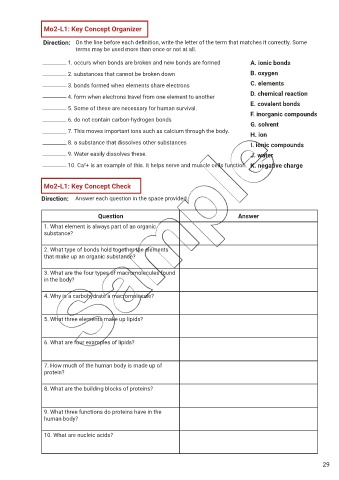
Mo2-L1: Key Concept Organizer

                Direction: On the line before each definition, write the letter of the term that matches it correctly. Some
                            terms may be used more than once or not at all.

                         1. occurs when bonds are broken and new bonds are formed        A. ionic bonds
                         2. substances that cannot be broken down                        B. oxygen

                         3. bonds formed when elements share electrons                   C. elements
                                                                                         D. chemical reaction
                         4. form when electrons travel from one element to another
                                                                                         E. covalent bonds
                         5. Some of these are necessary for human survival.
                                                                                         F. inorganic compounds
                         6. do not contain carbon-hydrogen bonds
                                                                                         G. solvent
                         7. This moves important ions such as calcium through the body.
                                                                                         H. ion
                         8. a substance that dissolves other substances                  I. ionic compounds

                         9. Water easily dissolves these.                                J. water
                         10. Ca + is an example of this. It helps nerve and muscle cells function. K. negative charge
                               2


                 Mo2-L1: Key Concept Check

                Direction:  Answer each question in the space provided.

                                   Question                                          Answer

                 1. What element is always part of an organic
                 substance?


                 2. What type of bonds hold together the elements
                 that make up an organic substance?


                 3. What are the four types of macromolecules found
                 in the body?


                 4. Why is a carbohydrate a macromolecule?


                 5. What three elements make up lipids?


                 6. What are four examples of lipids?


                 7. How much of the human body is made up of
                 protein?

                 8. What are the building blocks of proteins?


                 9. What three functions do proteins have in the
                 human body?

                 10. What are nucleic acids?


                                                                                                                  29

