


Page 137 - Science Course 3 (Book 1)
P. 137
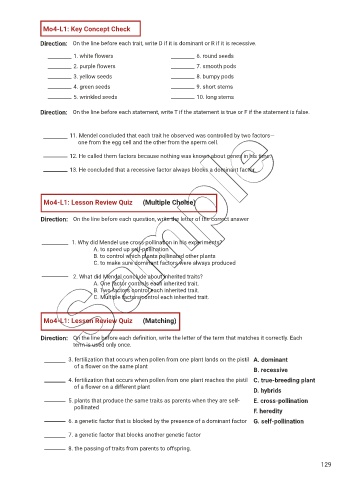
Mo4-L1: Key Concept Check


               Direction: On the line before each trait, write D if it is dominant or R if it is recessive.
                           1. white flowers                            6. round seeds

                           2. purple flowers                           7. smooth pods
                           3. yellow seeds                             8. bumpy pods
                           4. green seeds                              9. short stems
                           5. wrinkled seeds                           10. long stems


               Direction: On the line before each statement, write T if the statement is true or F if the statement is false.


                         11. Mendel concluded that each trait he observed was controlled by two factors—
                               one from the egg cell and the other from the sperm cell.

                         12. He called them factors because nothing was known about genes in his time.

                         13. He concluded that a recessive factor always blocks a dominant factor.


                 Mo4-L1: Lesson Review Quiz      (Multiple Choice)


               Direction: On the line before each question, write the letter of the correct answer


                          1. Why did Mendel use cross-pollination in his experiments?
                                  A. to speed up self-pollination
                                  B. to control which plants pollinated other plants
                                  C. to make sure dominant factors were always produced

                           2. What did Mendel conclude about inherited traits?
                                  A. One factor controls each inherited trait.
                                  B. Two factors control each inherited trait.
                                  C. Multiple factors control each inherited trait.


                 Mo4-L1: Lesson Review Quiz      (Matching)


               Direction: On the line before each definition, write the letter of the term that matches it correctly. Each
                           term is used only once.

                         3. fertilization that occurs when pollen from one plant lands on the pistil   A. dominant
                             of a flower on the same plant
                                                                                          B. recessive
                         4. fertilization that occurs when pollen from one plant reaches the pistil   C. true-breeding plant
                             of a flower on a different plant
                                                                                          D. hybrids
                         5. plants that produce the same traits as parents when they are self-   E. cross-pollination
                             pollinated
                                                                                          F. heredity
                         6. a genetic factor that is blocked by the presence of a dominant factor  G. self-pollination

                         7. a genetic factor that blocks another genetic factor

                         8. the passing of traits from parents to offspring.


                                                                                                                  129

