


Page 151 - Science Course 3 (Book 1)
P. 151
Mo4-L3b: How DNA Changes Affect Traits?


               The 46 human chromosomes contain between           The effects of a mutation depend on where in the
               20,000 and 25,000 genes that are copied during     DNA sequence the mutation happens and the type
               replication.                                       of mutation. Some mutations in human DNA cause
                                                                  genetic disorders.
               Mutations can be triggered by exposure to X-rays,
               ultraviolet light, radioactive materials, and some
               kinds of chemicals.


               There are several types of mutations.


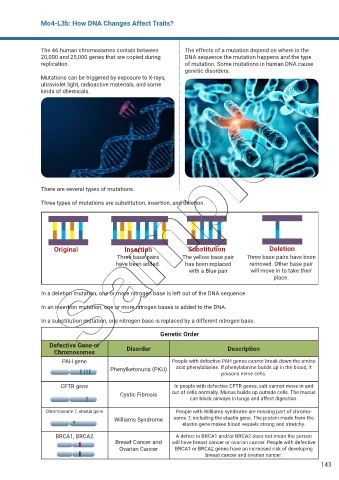
               Three types of mutations are substitution, insertion, and deletion.


                    Original                 Insertion             Substitution                 Deletion
                                          Three base pairs       The yellow base pair   Three base pairs have been
                                          have been added.        has been replaced      removed. Other base pair
                                                                   with a Blue pair      will move in to take their
                                                                                                 place.

                In a deletion mutation, one or more nitrogen base is left out of the DNA sequence.

                In an insertion mutation, one or more nitrogen bases is added to the DNA.

                In a substitution mutation, one nitrogen base is replaced by a different nitrogen base.

                                                         Genetic Order

                  Defective Gene or          Disorder                            Description
                    Chromosomes
                       PAH gene                              People with defective PAH genes cannot break down the amino
                                        Phenylketonuria (PKU)  acid phenylalanine. If phenylalanine builds up in the blood, it
                                                                               poisons nerve cells.

                      CFTR gene                               In people with defective CFTR genes, salt cannot move in and
                                           Cystic Fibrosis   out of cells normally. Mucus builds up outside cells. The mucus
                                                                    can block airways in lungs and affect digestion.

                 Chromosome 7, elastin gene                    People with Williams syndrome are missing part of chromo-
                                         Williams Syndrome    some 7, including the elastin gene. The protein made from the
                                                                 elastin gene makes blood vessels strong and stretchy.

                     BRCA1, BRCA2                              A defect in BRCA1 and/or BRCA2 does not mean the person
                                          Breast Cancer and  will have breast cancer or ovarian cancer. People with defective
                                           Ovarian Cancer     BRCA1 or BRCA2 genes have an increased risk of developing
                                                                         breast cancer and ovarian cancer.
                                                                                                                  143

