


Page 74 - Science Course 3 (Book 1)
P. 74
Mo2-L4a: How Do Organisms in an Ecosystem Interact?


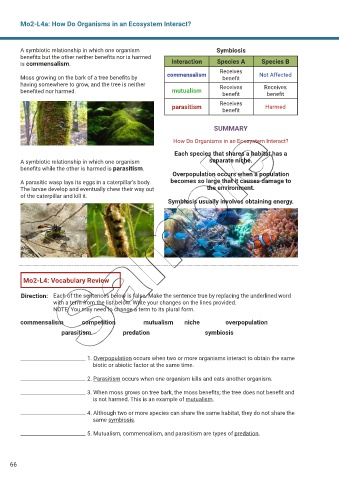
        A symbiotic relationship in which one organism                       Symbiosis
        benefits but the other neither benefits nor is harmed
        is commensalism.                                     Interaction     Species A       Species B
                                                                              Receives
        Moss growing on the bark of a tree benefits by      commensalism       benefit      Not Affected
        having somewhere to grow, and the tree is neither                     Receives        Receives
        benefited nor harmed.                                mutualism         benefit         benefit

                                                                              Receives
                                                             parasitism                       Harmed
                                                                               benefit

                                                                            SUMMARY

                                                              How Do Organisms in an Ecosystem Interact?

                                                              Each species that shares a habitat has a
        A symbiotic relationship in which one organism                    separate niche.
        benefits while the other is harmed is parasitism.
                                                              Overpopulation occurs when a population
        A parasitic wasp lays its eggs in a caterpillar’s body.  becomes so large that it causes damage to
        The larvae develop and eventually chew their way out              the environment.
        of the caterpillar and kill it.
                                                            Symbiosis usually involves obtaining energy.


          Mo2-L4: Vocabulary Review


        Direction: Each of the sentences below is false. Make the sentence true by replacing the underlined word
                    with a term from the list below. Write your changes on the lines provided.
                    NOTE: You may need to change a term to its plural form.

        commensalism          competition          mutualism      niche         overpopulation
                       parasitism           predation                    symbiosis


                                1. Overpopulation occurs when two or more organisms interact to obtain the same
                                    biotic or abiotic factor at the same time.

                                2. Parasitism occurs when one organism kills and eats another organism.

                                3. When moss grows on tree bark, the moss benefits; the tree does not benefit and
                                    is not harmed. This is an example of mutualism.

                                4. Although two or more species can share the same habitat, they do not share the
                                    same symbiosis.

                                5. Mutualism, commensalism, and parasitism are types of predation.


     66

