


Page 168 - Math Course 2 (Book 2)
P. 168
Inductive Reasoning and Conjecture
         Mo. 12


           Lesson 1
                                                                         Let’s Begin


          KEY CONCEPTS:

          1. Make conjectures based on inductive           Patterns and Conjecture
              reasoning.
          2. Find counterexamples.                            Example


                                                            Make a conjecture about the next number based
         MO. 12 - L1a                                       on the pattern. 2, 4, 12, 48, 240


                Conjectures Based on                        Find the pattern:
                 Inductive Reasoning                           2        4        12       48       240


                     Vocabulary A-Z                                x2       x3       x4        x5

                     Let us learn some vocabulary
                                                            The numbers are multiplied by 2, 3, 4, and 5.

         conjecture                                         Conjecture:   The next number will be multiplied
         is an educated guess based on known information.                 by 6. So, it will be 6 • 240 or 1440.


                                                               Answer                  1440


                                                           Geometric Conjecture

                                                              Example


         Inductive reasoning
         is reasoning that uses a number of specific        For points L, M, and N, LM = 20, MN = 6, and
                                                            LN = 14. Make a conjecture and draw a figure
         examples to arrive at a plausible generalization    to illustrate your conjecture.
         or prediction.

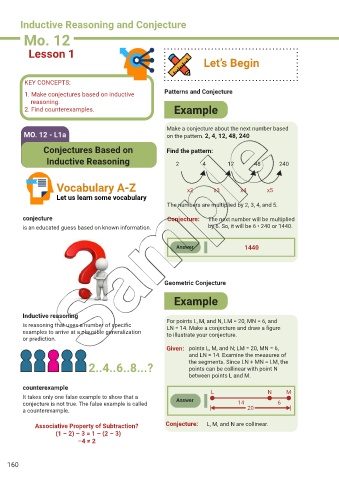
                                                           Given: points L, M, and N; LM = 20, MN = 6,
                                                                   and LN = 14. Examine the measures of
                                2..4..6..8...?                     the segments. Since LN + MN = LM, the
                                                                   points can be collinear with point N
                                                                   between points L and M.
         counterexample                                                    L                   N      M
         It takes only one false example to show that a        Answer
         conjecture is not true. The false example is called                         14            6
         a counterexample.                                                              20

             Associative Property of Subtraction?          Conjecture:    L, M, and N are collinear.
                     (1 – 2) – 3 = 1 – (2 – 3)
                            –4 ≠ 2


    160

