


Page 48 - Science Course 2 (Book 1)
P. 48
Mo2-L3a:  How Do Nutrients Enter and  Mo2-L3a:  How Do Nutrients Enter and Leave the Body?
            Leave the Body?


                Digestion and Excretion                           Some foods, like insoluble fiber, that are not digested
                                                                  leave the body through the rectum.
                Organ systems provide movement, transport
                substances, and perform many other functions.     The rectum of the large intestine stores the solid
                                                                  waste until the waste is expelled from the body.
                Organ systems work together and maintain
                homeostasis, or steady internal conditions
                when external conditions change.                  Nutrients are the parts of
                                                                  food used by the body
                   Hypo-        Homeostasis          Hyper-       to grow and survive.

                                                                  Proteins, fats,
                                                                  carbohydrates,
                                                                  vitamins, and
                                                                  minerals are all
                                                                  nutrients.
                The human body breaks down food through the
                process of digestion.

                Substances that are not used by the body are
                removed through the digestive system and by the   Calories are a measure of the amount of energy in
                excretory system.                                 food.
                                                                       Calories in             Calories out
                                                                          Food                Body Functions
                Digestion                                               Beverages             Physical Activity

                Food enters the digestive system through the mouth.


                   Mouth

                                                  Esophagus


                     Liver                        Stomach
                    Large                         Small
                 intestine                        Intestine
                  (colon)
                                                  Rectum


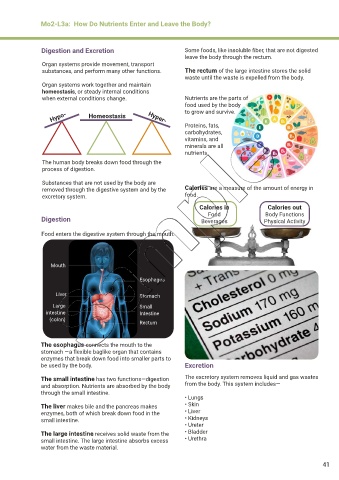
               The esophagus connects the mouth to the
               stomach —a flexible baglike organ that contains
               enzymes that break down food into smaller parts to
               be used by the body.                               Excretion

               The small intestine has two functions—digestion    The excretory system removes liquid and gas wastes
               and absorption. Nutrients are absorbed by the body   from the body. This system includes—
               through the small intestine.
                                                                  • Lungs
               The liver makes bile and the pancreas makes        • Skin
               enzymes, both of which break down food in the      • Liver
               small intestine.                                   • Kidneys
                                                                  • Ureter
               The large intestine receives solid waste from the   • Bladder
               small intestine. The large intestine absorbs excess   • Urethra
               water from the waste material.


                                                                                                                  41

