


Page 53 - Science Course 2 (Book 1)
P. 53
Mo2-L3c:  How Does the Body Protect Itself From Harmful Invaders?


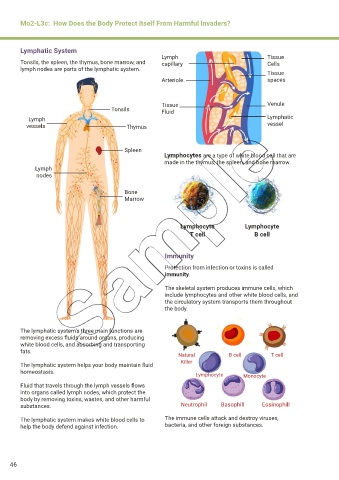
        Lymphatic System
                                                          Lymph                                Tissue
        Tonsils, the spleen, the thymus, bone marrow, and   capillary                          Cells
        lymph nodes are parts of the lymphatic system.
                                                                                               Tissue
                                                          Arteriole                            spaces


                                                          Tissue                               Venule
                                        Tonsils           Fluid
           Lymph                                                                               Lymphatic
          vessels                            Thymus                                            vessel


                                             Spleen
                                                           Lymphocytes are a type of white blood cell that are
                                                           made in the thymus, the spleen, and bone marrow.
             Lymph
              nodes

                                             Bone
                                             Marrow


                                                                Lymphocyte             Lymphocyte
                                                                    T cell                B cell


                                                           Immunity

                                                           Protection from infection or toxins is called
                                                           immunity.

                                                           The skeletal system produces immune cells, which
                                                           include lymphocytes and other white blood cells, and
                                                           the circulatory system transports them throughout
                                                           the body.


        The lymphatic system’s three main functions are
        removing excess fluids around organs, producing
        white blood cells, and absorbing and transporting
        fats.
                                                                Natural          B cell         T cell
                                                                 Killer
        The lymphatic system helps your body maintain fluid
        homeostasis.
                                                                      Lymphocyte      Monocyte
        Fluid that travels through the lymph vessels flows
        into organs called lymph nodes, which protect the
        body by removing toxins, wastes, and other harmful
        substances.                                              Neutrophil    Basophill     Eosinophill

        The lymphatic system makes white blood cells to    The immune cells attack and destroy viruses,
        help the body defend against infection.            bacteria, and other foreign substances.


     46

