


Page 120 - Science Course 3 (Book 1)
P. 120
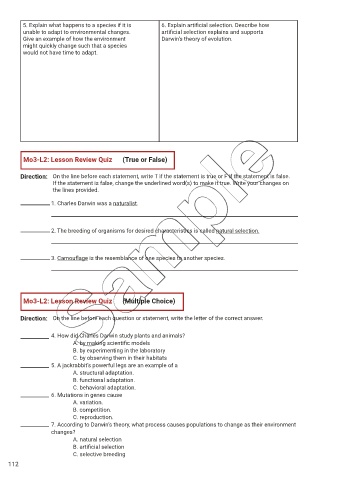
5. Explain what happens to a species if it is    6. Explain artificial selection. Describe how
         unable to adapt to environmental changes.        artificial selection explains and supports
         Give an example of how the environment           Darwin’s theory of evolution.
         might quickly change such that a species
         would not have time to adapt.


          Mo3-L2: Lesson Review Quiz      (True or False)


        Direction: On the line before each statement, write T if the statement is true or F if the statement is false.
                    If the statement is false, change the underlined word(s) to make it true. Write your changes on
                    the lines provided.

                   1. Charles Darwin was a naturalist.


                   2. The breeding of organisms for desired characteristics is called natural selection.


                   3. Camouflage is the resemblance of one species to another species.


          Mo3-L2: Lesson Review Quiz      (Multiple Choice)


        Direction: On the line before each question or statement, write the letter of the correct answer.


                   4. How did Charles Darwin study plants and animals?
                           A. by making scientific models
                           B. by experimenting in the laboratory
                           C. by observing them in their habitats
                   5. A jackrabbit’s powerful legs are an example of a
                           A. structural adaptation.
                           B. functional adaptation.
                           C. behavioral adaptation.
                   6. Mutations in genes cause
                           A. variation.
                           B. competition.
                           C. reproduction.
                   7. According to Darwin’s theory, what process causes populations to change as their environment
                   changes?
                           A. natural selection
                           B. artificial selection
                           C. selective breeding
    112

