


Page 189 - Math Course 2 (Book 2)
P. 189
Postulates and Paragraph Proofs


               Use Postulates                                     Determine Valid Conclusions

                   Example                                         Determine whether each statement is always,
                                                                   sometimes, or never true. Explain.


                                                                   Plane A and plane B intersect in exactly one point.
                 Determine whether the following statement is
                 always, sometimes, or never true. Explain.        A .always
                                  ↔     ↔                          B. sometimes
                 If plane T contains EF and EF contains point G,    C. never
                 then plane T contains point G.
                                                                     Answer
                                 Always; Postulate 12.5 states
                                 that if two points lie in a plane,
                    Answer
                                 then the entire line containing
                                 those points lies in the plane.   Point N lies in plane X and point R lies in plane
                                                                   Z. You can draw only one line that contains both
                        If two points lie in a line, then the entire line
                  12.5  containing those points lies in that plane.   points N and R.

                                                                   A .always
                 Determine whether the following statement is      B. sometimes
                 always, sometimes, or never true. Explain         C. never
                    ↔
                 For XY, if X lies in plane Q and Y lies in plane R,
                                                                     Answer
                 then plane Q intersects plane R.


                                Sometimes; planes Q and R can
                                 be parallel (which means they
                    Answer                                         Two planes will always intersect to form a line.
                                  don’t intersect), and XY can
                                     intersect both planes.        A .always
                                                                   B. sometimes
                 Determine whether the following statement is      C. never

                 always, sometimes, or never true. Explain           Answer
                 ↔
                 GH contains three noncollinear points.

                                Never; noncollinear points do not
                    Answer
                                lie on the same line by definition.


                Your Turn!


               Determine Valid Conclusions

                 ART
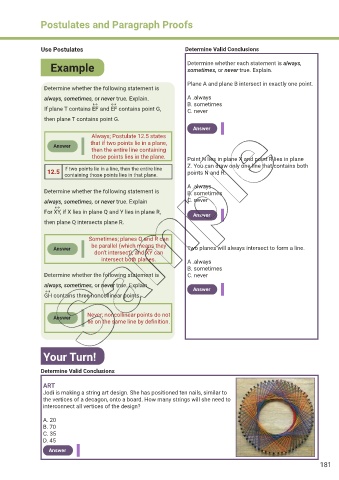
                 Jodi is making a string art design. She has positioned ten nails, similar to
                 the vertices of a decagon, onto a board. How many strings will she need to
                 interconnect all vertices of the design?

                 A. 20
                 B. 70
                 C. 35
                 D. 45
                  Answer

                                                                                                                 181

