


Page 193 - Math Course 2 (Book 2)
P. 193
Two-Column Algebraic Proof
                 Mo. 12


                  Lesson 6                                         formal proof

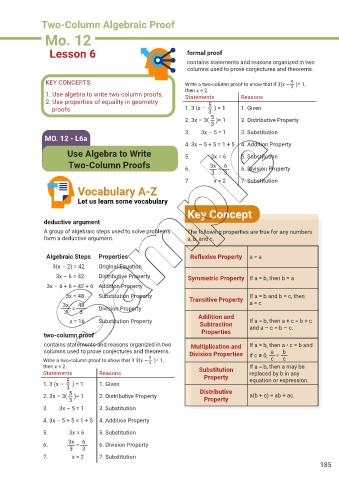
                                                                   contains statements and reasons organized in two
                                                                   columns used to prove conjectures and theorems.

                 KEY CONCEPTS:                                    Write a two-column proof to show that if 3(x –     )= 1,
                                                                                                       5
                                                                  then x = 2.                          3
                 1. Use algebra to write two-column proofs.       Statements          Reasons
                 2. Use properties of equality in geometry                5
                     proofs.                                      1. 3 (x –      ) = 1  1. Given
                                                                          3
                                                                           5
                                                                  2. 3x – 3(     )= 1  2. Distributive Property
                                                                           3
                                                                  3.        3x – 5 = 1  3. Substitution
                 MO. 12 - L6a
                                                                  4. 3x – 5 + 5 = 1 + 5  4. Addition Property
                         Use Algebra to Write                     5.               3x = 6  5. Substitution

                         Two-Column Proofs                                 3x   6
                                                                  6.                    =
                                                                           3    3     6. Division Property
                                                                  7.                 x = 2  7. Substitution
                            Vocabulary A-Z

                            Let us learn some vocabulary
                                                                   Key Concept

                deductive argument
                A group of algebraic steps used to solve problems   The following properties are true for any numbers
                form a deductive argument.                         a, b, and c.


                 Algebraic Steps    Properties                      Reflexive Property   a = a

                   3(x – 2) = 42    Original Equation
                      3x – 6 = 42   Distributive Property          Symmetric Property If a = b, then b = a
                  3x – 6 + 6 = 42 + 6 Addition Property
                             3x = 48  Substitution Property        Transitive Property   If a = b and b = c, then
                       3x   48                                                           a = c
                              =  3  Division Property
                        3
                               x = 16  Substitution Property           Addition and      If a = b, then a + c = b + c
                                                                       Subtraction
                                                                                         and a – c = b – c.
                two-column proof                                        Properties
                contains statements and reasons organized in two    Multiplication and   If a = b, then a • c = b and
                columns used to prove conjectures and theorems.     Division Properties  if c ≠ 0,      =   b
                                                                                                a
                                                     5
                Write a two-column proof to show that if 3(x –     )= 1,                        c   c
                                                     3
                then x = 2.                                            Substitution      If a = b, then a may be
                Statements          Reasons                                              replaced by b in any
                        5                                                Property        equation or expression.
                1. 3 (x –      ) = 1  1. Given
                        3                                              Distributive
                         5
                2. 3x – 3(     )= 1  2. Distributive Property                            a(b + c) = ab + ac.
                         3                                               Property
                3.        3x – 5 = 1  3. Substitution
                4. 3x – 5 + 5 = 1 + 5  4. Addition Property

                5.               3x = 6  5. Substitution
                         3x
                6.                    =  6  6. Division Property
                         3    3
                7.                 x = 2  7. Substitution
                                                                                                                 185

