


Page 121 - Math Course 3 (Book 1)
P. 121
Linear Equations: Rate of Change


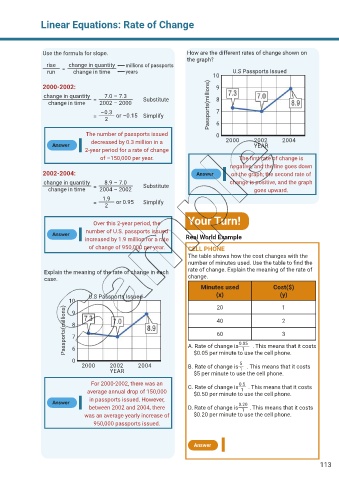
                Use the formula for slope.                         How are the different rates of change shown on
                                                                   the graph?
                 rise    change in quantity  millions of passports
                  run  =   change in time    years                                 U.S Passports Issued
                                                                            10
                2000-2002:                                                   9
                change in quantity    7.0 – 7.3    Substitute                8
                  change in time  =  2002 – 2000                          Passports(millions)
                                    –0.3                                     7
                                  =   2   or –0.15  Simplify                 6

                               The number of passports issued                0
                                 decreased by 0.3 million in a                  2000      2002      2004
                   Answer                                                                 YEAR
                               2-year period for a rate of change
                                    of –150,000 per year.                            The first rate of change is
                                                                                  negative, and the line goes down
                2002-2004:                                            Answer      on the graph; the second rate of
                change in quantity    8.9 – 7.0    Substitute                     change is positive, and the graph
                  change in time  =  2004 – 2002                                          goes upward.
                                     1.9
                                  =   2   or 0.95  Simplify

                                                                   Your Turn!
                                  Over this 2-year period, the
                               number of U.S. passports issued
                   Answer
                               increased by 1.9 million for a rate   Real World Example
                                of change of 950,000 per year.     CELL PHONE
                                                                   The table shows how the cost changes with the
                                                                   number of minutes used. Use the table to find the
                 Explain the meaning of the rate of change in each   rate of change. Explain the meaning of the rate of
                 case.                                             change.
                                                                        Minutes used             Cost($)
                                U.S Passports Issued                         (x)                   (y)
                         10                                                  20                     1
                        Passports(millions)  8                     A. Rate of change is          . This means that it costs
                          9
                                                                             40
                                                                                                    2
                                                                                                    3
                                                                             60
                          7
                                                                                     0.05
                          6
                                                                                      1
                          0                                            $0.05 per minute to use the cell phone.
                                                                                     5
                              2000      2002      2004             B. Rate of change is      . This means that it costs
                                                                                     1
                                        YEAR                           $5 per minute to use the cell phone.
                                 For 2000-2002, there was an       C. Rate of change is       . This means that it costs
                                                                                     0.5
                                                                                      1
                                average annual drop of 150,000         $0.50 per minute to use the cell phone.
                                in passports issued. However,
                   Answer                                                            0.20
                                between 2002 and 2004, there       D. Rate of change is        . This means that it costs
                                                                                      1
                               was an average yearly increase of       $0.20 per minute to use the cell phone.
                                  950,000 passports issued.


                                                                     Answer


                                                                                                                 113

