


Page 128 - Math Course 1 (Book 2)
P. 128
Geometric Area: Parallelogram


            Opposite sides have the same slope, so they are   Perimeter of ABCD             Def nition of
            parallel.  ABCD  is  a  parallelogram. The  slopes  of   = AB + BC + CD + AD    perimeter
            the consecutive sides are negative reciprocals of
            each other, so the sides are perpendicular. Thus,   =           +           +           +  10  Substitution.
                                                                 40
                                                                             40
                                                                       10
            the parallelogram is a rectangle. In order for the
            rectangle to be a square, all sides must be equal.                              Simplify
            Use the Distance Formula to f nd the side lengths.  = 2            +          + 2           + 10
                                                                                 10
                                                                   10
                                                                         10
                                                                                            radicals.
                                               2
                     2
          AB =  (x –x ) + (y –y ) 2  BC =  (x –x ) + (y –y ) 2                              Add like
                 2  1     2  1            2  1     2  1      = 6   10
                                                                                            terms.
                                                2
             =  (1–3)   + [4–(–2)]  2  =  (–2–1)   + [3–4]  2
                     2
                                                                Answer                6   10
             = 40                     = 10
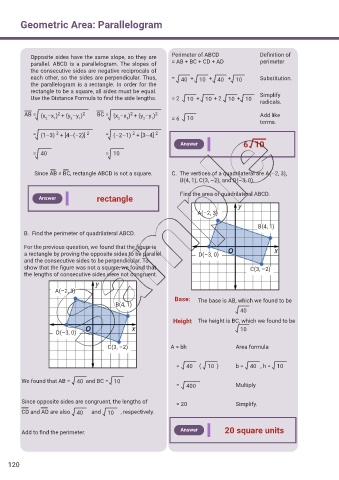
             Since AB ≠ BC, rectangle ABCD is not a square.  C.  The vertices of a quadrilateral are A(–2, 3),
                                                                   B(4, 1), C(3, –2), and D(–3, 0).

                                                                   Find the area of quadrilateral ABCD.
               Answer              rectangle

                                                                      A(–2, 3)

                                                                                            B(4, 1)
         B.  Find the perimeter of quadrilateral ABCD.

         For the previous question, we found that the f gure is
         a rectangle by proving the opposite sides to be parallel      D(–3, 0)
         and the consecutive sides to be perpendicular. To
         show that the f gure was not a square, we found that                            C(3, –2)
         the lengths of consecutive sides were not congruent.


                    A(–2, 3)
                                                              Base:   The base is AB, which we found to be
                                          B(4, 1)
                                                                                     40

                                                              Height  The height is BC, which we found to be
                                                                                     10
                     D(–3, 0)
                                       C(3, –2)              A = bh                 Area formula


                                                                          10
                                                                                         40
                                                                  40
                                                                 =              (           )  b =            , h =  10
                            40
         We found that AB =           and BC =  10
                                                                 =  400             Multiply
         Since opposite sides are congruent, the lengths of      = 20               Simplify.

         CD and AD are also               and              , respectively.
                                       10
                            40
         Add to f nd the perimeter.                             Answer          20 square units


    120

